Moving to Spain
Choosing a school in Málaga: what we learned after moving here
Public, concertado or international? A personal reflection on finding the right school — and unlearning the assumptions we brought with us.
10 min read
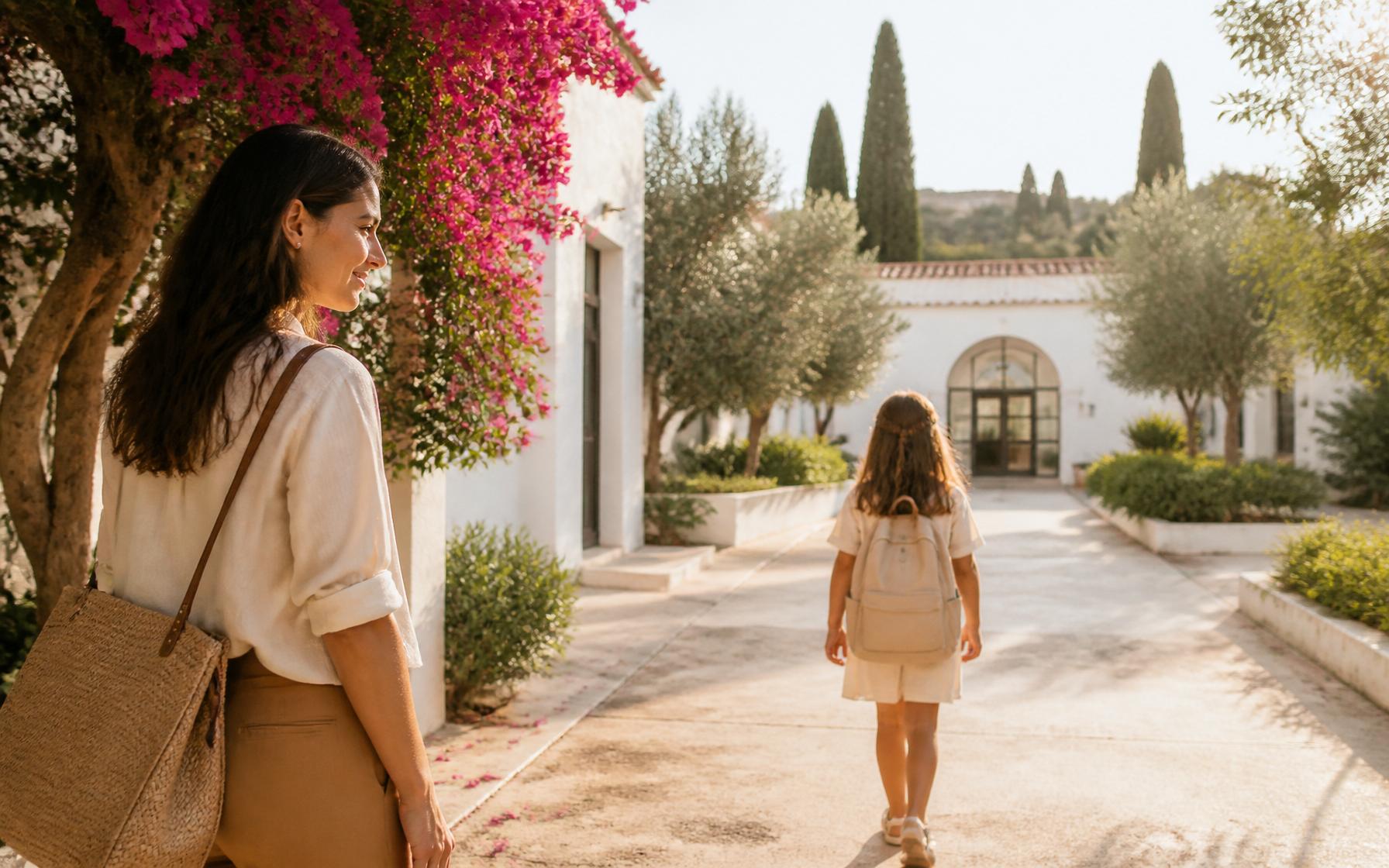
When we started planning our move to Málaga, I thought choosing a school would be one of the easiest decisions. It turned out to be one of the most emotional — and one of the most important.
Before moving to Spain, I had already decided where my daughter would go to school.
Or at least, I thought I had.
Like many international families, I assumed we would choose an international school. We were moving from abroad, English was already part of our daily life, and it simply felt like the logical path.
I spent hours looking at beautiful campuses, reading websites and comparing international curricula.
Public schools weren't really on my radar.
Not because I had researched them and decided against them.
Simply because I carried assumptions from my own experience growing up in Argentina.
There, public education can vary significantly depending on the area. Teacher strikes are not unusual, resources aren't always equal, and many families who have the opportunity choose private education.
So, naturally, I expected Spain to be similar.
I couldn't have been more wrong.
The first thing that surprised me
Once we actually arrived in Málaga, we started visiting schools instead of just reading about them online.
We spoke to parents.
We visited campuses.
We asked questions.
And slowly, my perspective began to change.
One thing became immediately clear:
Public education in Spain is respected.
Not as a "second option."
Not as something families choose only because they cannot afford private education.
Many parents actively choose public schools because they genuinely believe they offer an excellent education.
That completely challenged the assumptions I had arrived with.
Understanding the different types of schools
Before comparing schools, it helps to understand how the Spanish education system works.
Public schools
Public schools are funded by the government and are free to attend, although families still pay for items such as school supplies, lunch services, excursions and some extracurricular activities.
Most classes are taught in Spanish.
For families planning to build a long-term life in Spain, public schools can offer something invaluable: full integration into the local community.
Children learn the language naturally, make Spanish friends and become part of everyday life rather than living inside an international bubble.
Concertado schools
Concertado schools are privately managed but receive public funding.
They often combine smaller class sizes, religious or educational traditions and bilingual programmes while remaining considerably more affordable than fully private schools.
For many Spanish families, they represent a balance between public and private education.
International schools
International schools generally follow a British, American or International Baccalaureate curriculum and teach primarily in English.
They're an excellent option for many families, especially if:
- · you're planning to relocate again in the future;
- · your children already study in English;
- · you want continuity with another education system; or
- · you're preparing for university abroad.
However, tuition fees, registration costs, transport, uniforms and extracurricular activities can make them one of the largest expenses in a family's annual budget.
There isn't a "best" school
One question appears constantly in relocation groups.
"What's the best school in Málaga?"
The truth is...
There isn't one.
There is only the school that's best for your family.
A family planning to stay in Spain permanently may have completely different priorities from one relocating for two years.
A five-year-old who doesn't yet speak Spanish has different needs from a fourteen-year-old preparing for university.
The right school depends on your family's goals, not on online rankings.
The question that changed everything for me
At some point I stopped asking:
"Which school has the best reputation?"
Instead, I started asking:
"What kind of childhood do I want my children to have?"
That single question completely changed the way I evaluated schools.
Because choosing a school isn't only choosing where your child will study.
You're also choosing:
- · where they'll make friends;
- · what language they'll dream in;
- · what culture they'll grow up surrounded by;
- · and what everyday life will look like for your family.
My biggest surprise
This was probably the moment that changed my perspective the most.
I expected to fall in love with international schools.
Instead, I found myself increasingly appreciating public education.
Not simply because it's free.
But because of the atmosphere.
One of the things I noticed during our visits was that public schools felt incredibly... normal.
Children were simply children.
I didn't have the impression that anyone cared what their parents did for a living, what car they drove or where they came from.
The focus seemed to be exactly where I hoped it would be:
- · Learning.
- · Playing.
- · Growing up.
- · Making friends.
During some visits to international schools, I personally felt there was a greater emphasis on parents' professional backgrounds and lifestyles. That was simply my own impression during the admissions process, and I'm sure experiences vary from one school to another.
It wasn't necessarily something anyone said.
It was more a feeling.
And it made me reflect on what mattered most for our family.
Things I wish someone had told me
If I could go back and speak to myself before moving to Spain, this is what I would say.
Don't choose a school because the building is beautiful. Children won't remember the architecture. They'll remember how they felt every morning when they walked through the gates.
Don't underestimate the commute. A fantastic school forty-five minutes away sounds manageable. Until you're driving there twice every day. For years.
Visit during a normal school day. Websites are designed for marketing. A regular Tuesday morning tells you much more.
Watch the children. Observe how teachers interact with them. Listen to the atmosphere.
Talk to other parents. Not just the school. Parents often tell you things brochures never will.
Questions worth asking during your visit
Instead of only asking about academic results, consider asking:
- · How do you support children who don't speak Spanish?
- · What does a typical school day look like?
- · How much homework is expected?
- · What extracurricular activities are included?
- · How are conflicts between students handled?
- · How often do teachers communicate with parents?
- · What happens if a child needs additional learning support?
Sometimes the answers to these questions tell you far more than any league table.
So... which school did we choose?
People often ask me which school I recommend.
Honestly?
I think that's the wrong question.
The better question is:
"What kind of life do you want to build in Spain?"
Because once you answer that, the right school usually becomes much clearer.
Some families will absolutely thrive in an international school.
Others will fall in love with public education.
Many will find that a concertado school offers exactly the balance they're looking for.
None of those choices are inherently better than the others.
They're simply different paths.
Final thoughts
Looking back, I'm grateful I arrived with assumptions.
Because it forced me to question them.
Moving abroad isn't only about discovering a new country.
It's also about discovering that many of the ideas we thought were true don't always travel with us.
Choosing a school was one of those moments.
I arrived convinced that an international school was the obvious choice.
I left the process with a much deeper appreciation for Spain's public education system and a better understanding that the "best" school isn't always the most expensive one.
It's the place where your child feels safe.
Where they're excited to learn.
Where they build friendships.
And where your family begins to feel at home.
Because at the end of the day, that's what moving to Málaga is really about.
Not just finding a house.
But building a life.
Continue reading
Planning the move with children?
Our guide Moving to Málaga with Kids covers schools, visas, healthcare and the practical decisions that come with relocating your family to the Costa del Sol.
Related reading
Keep exploring life in Málaga
Living in Málaga
The Real Cost of Living in Málaga for Families (2026)
A realistic look at what a family of four actually spends living in Málaga in 2026—from housing and groceries to schools, healthcare and everyday expenses.
Education
I Thought Changing Schools Would Be Simple
A small school decision that made me realize how complicated starting over in a new country can be.
Living in Málaga
15 Things That Surprised Us After Moving from Boston to Málaga (That Nobody Told Us)
Moving abroad isn't just about learning a new city—it's about discovering a completely different way of living. These are the moments that genuinely surprised our family after moving from Boston to Málaga.
Guides & journals
Moving to Málaga with Kids
The complete relocation handbook for international families — 12 practical chapters and printable checklists.