Living in Málaga
Pedregalejo vs Málaga Centro With Kids: Which Is Better for Family Life?
Moving to Málaga with children? Here’s how two of the city’s most popular areas compare when you look beyond the holiday and think about everyday family life.
9 min read
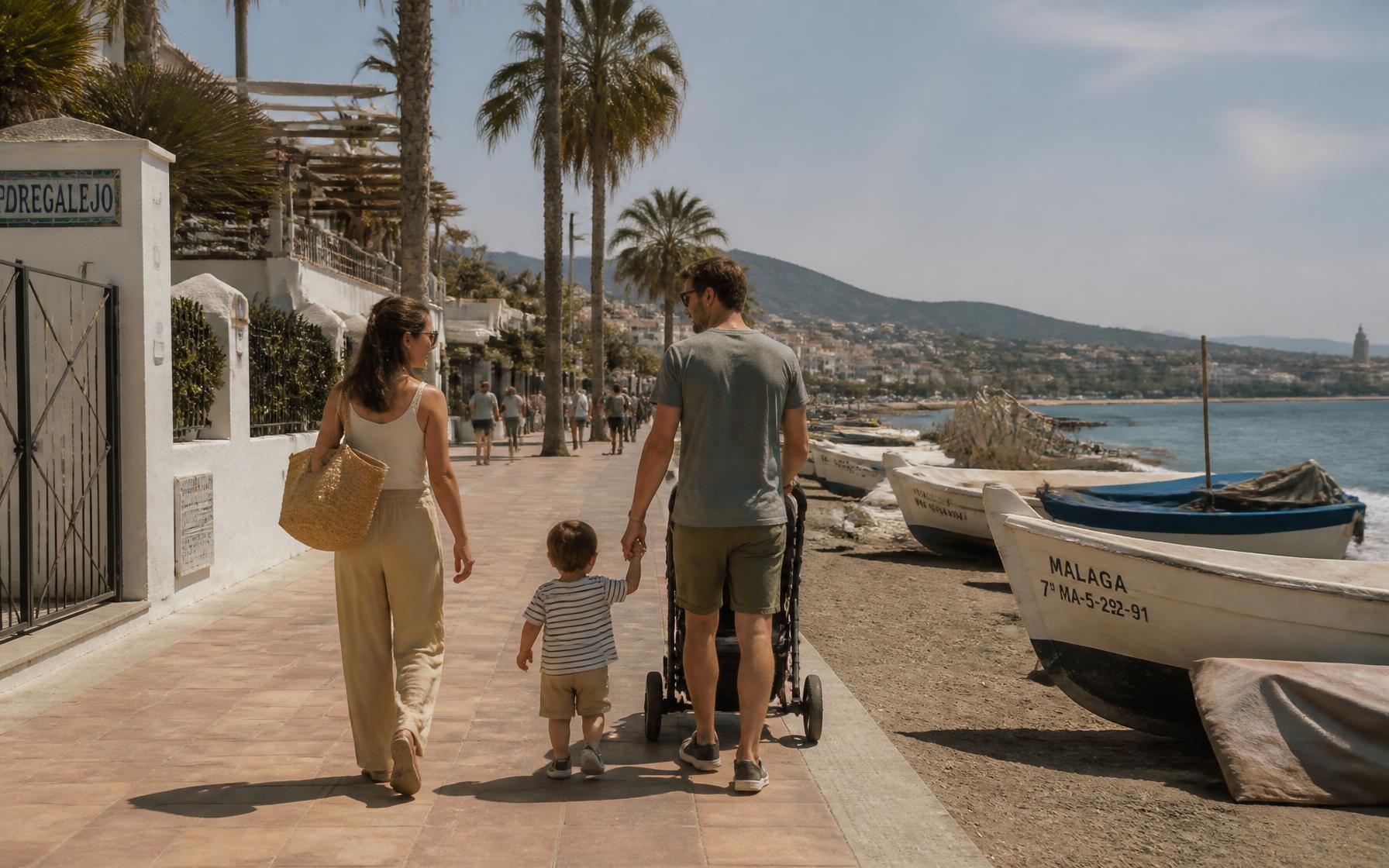
Choosing where to live in Málaga feels very different once you have children.
Before kids, you might choose a neighbourhood because of its restaurants, architecture or proximity to nightlife. With children, the questions become surprisingly practical.
Can we walk to the supermarket with a stroller? Is there somewhere easy to go after school? How far is the nursery? Can the kids run around without every outing becoming an organised activity? What happens when everyone needs to leave the house at 5 p.m.?
Two areas that often come up for international families are Pedregalejo and Málaga Centro.
They aren’t particularly far from each other, but family life in them can feel very different.
And neither is universally better.
The better question is: what do you want an ordinary Tuesday in Málaga to look like?
The short answer
Choose Pedregalejo if you’re imagining a quieter, coastal version of Málaga where the beach and promenade become part of everyday family life.
Choose Málaga Centro if you want the city outside your door: museums, restaurants, cafés, shops, markets and cultural life within easy reach.
For families with young children who prioritise outdoor space and the sea, we’d lean towards Pedregalejo.
For families who want maximum access to city life and don’t mind a busier environment, Centro can be wonderful.
But there are some important trade-offs.
Living in Pedregalejo with kids
Pedregalejo sits east of Málaga’s historic centre, along the coast.
And its biggest advantage for families is incredibly simple: the beach isn’t an activity you have to plan. It can become part of normal life.
You can walk along the promenade after nursery, stop at the beach for half an hour, take scooters out, have an ice cream or simply walk beside the sea when everyone has been inside for too long.
With small children, that convenience matters more than you might expect.
There’s also a stronger residential feeling than in the busiest parts of the historic centre. You’re still surrounded by restaurants, cafés, supermarkets and Málaga’s characteristic beachfront chiringuitos, but daily life can feel noticeably slower.
If the Málaga you’re imagining involves sandy shoes by the front door, walks along the promenade and spontaneous afternoons outside, Pedregalejo probably comes closer to that picture.
What families may love about Pedregalejo
The beach becomes part of your routine. You don’t need to pack the car or organise an entire beach day every time the children want to see the sea.
Outdoor life is easy. The promenade gives families a natural place for walking, scooters, bikes and those aimless outings that become very useful when you have young children.
It feels residential. Although Pedregalejo is certainly popular with visitors, it still has the feeling of a neighbourhood where people actually live.
Life feels slightly slower. You’re close to central Málaga without necessarily feeling that you’re living in the middle of a major tourist destination.
The trade-off with Pedregalejo
You’re not in Centro.
That sounds obvious, but it’s worth thinking about what it means in practice.
You won’t have Málaga’s largest concentration of museums, historic sights, shops and cultural activities immediately outside your door.
Going into Centro becomes a journey rather than simply walking downstairs and already being there.
For some families, that’s completely worth it.
For others — particularly those who want to live completely car-free and spend a lot of time in central Málaga — it may become annoying.
So don’t just ask yourself whether Pedregalejo is beautiful. Ask: how often will we realistically need to go into Centro?
Living in Málaga Centro with kids
Centro offers almost the opposite lifestyle.
You step outside and Málaga is happening around you.
Restaurants, cafés, shops, museums, historic streets and cultural activities are concentrated within a relatively small area.
For an international family arriving in Málaga for the first time, that can be incredibly attractive.
You don’t necessarily need to understand the entire city immediately because so much is accessible around you.
And there’s something genuinely lovely about children growing up with museums, markets and historic streets forming part of their normal environment.
But there’s an important distinction: walkable doesn’t always mean effortless with children.
Central Málaga can also mean crowds, tourists, events, noise and busy streets.
And with young children, sometimes what you need isn’t another attraction. You need somewhere they can move.
What families may love about Centro
Almost everything is close. Restaurants, cafés, shops, markets, museums and services are concentrated around you.
Culture becomes part of everyday life. Going to a museum or exhibition doesn’t necessarily need to become a major family excursion.
It’s extremely walkable. Families who actively want to minimise their dependence on a car may find this particularly appealing.
There’s always something happening. If you enjoy being surrounded by activity, Centro delivers that in a way Pedregalejo doesn’t.
The trade-off with Centro
You’re sharing the neighbourhood with a lot of other people who also want to experience Málaga.
Tourism, nightlife and events can dramatically change the feeling of individual streets.
That’s why simply searching for an apartment in “Málaga Centro” isn’t enough. The exact street matters.
A relatively peaceful residential street and an apartment above one of the busiest nightlife areas can produce completely different experiences while technically belonging to the same neighbourhood.
If you’re moving with children, we’d pay close attention to noise before signing anything — especially at night and on weekends.
What about nursery and preschool?
This is where we’d be careful about choosing a neighbourhood first and figuring out childcare afterwards.
For children aged 0–3, Andalucía has a formal admission system for publicly funded and participating early-childhood education centres. For the 2026/27 school year, for example, the ordinary application period ran from 1–30 April 2026 for children entering a centre for the first time. (Junta de Andalucía)
But that’s very different from asking: “Can my four-year-old attend somewhere for six weeks while we’re staying in Málaga?”
Short-term childcare, private nurseries, international options and regular school enrolment are different situations.
If you’re coming temporarily, looking for English-friendly care or arriving outside the normal enrolment calendar, contact individual centres before committing to accommodation.
Don’t assume you’ll arrive and easily find the arrangement you need.
For families moving permanently, we’d go even further: find the schools or nurseries you’re seriously considering and calculate the real morning journey from each potential home.
A neighbourhood can look perfect until you discover that your weekday starts with an inconvenient school run twice a day.
Related reading: Choosing a school in Málaga.
Pedregalejo vs Centro without a car
You can build a car-light or car-free life in either area, but the experience is different.
In Centro, walking is one of the biggest advantages. Much of what you’ll need — or simply want to do — is concentrated around you.
In Pedregalejo, everyday neighbourhood life can also be very walkable, particularly around the coast, but you’ll be more dependent on public transport, cycling or occasional taxis when you want to reach other parts of Málaga.
Before choosing either, we’d do something very unglamorous but incredibly useful: open a map and calculate the journey from the apartment you’re considering to your nursery or school, supermarket, healthcare centre and the places you’ll realistically visit every week.
Not the cathedral. Not the airport. Your actual Monday morning.
That’s the Málaga you’ll really be living in.
More on this: Do you really need a car on the Costa del Sol?
What is winter like with children?
If you’re considering spending February or March in Málaga, don’t imagine summer — but don’t imagine a northern European winter either.
According to Spain’s State Meteorological Agency (AEMET), Málaga Airport’s long-term climate averages show an average temperature of 12.9°C in February, with average daytime highs of 17.7°C. In March, the average rises to 14.7°C, with average highs of 19.6°C. (AEMET)
February historically averages around 60 mm of rainfall and March around 52 mm, while both months still receive substantial sunshine. (AEMET)
So yes, outdoor family life remains very possible.
But there will be cool mornings, rainy days and wind.
And there’s something we’d pay almost as much attention to as the neighbourhood: the apartment itself.
Orientation, direct sunlight, insulation, heating and humidity can make two homes in Málaga feel remarkably different during winter.
We wouldn’t choose between Pedregalejo and Centro because someone says one feels a degree warmer. We’d choose the better home.
Pedregalejo vs Málaga Centro: at a glance
| If your priority is… | We’d consider |
|---|---|
| Beach on your doorstep | Pedregalejo |
| Promenade life with children | Pedregalejo |
| A quieter neighbourhood feeling | Pedregalejo |
| Restaurants and city life | Centro |
| Museums and culture | Centro |
| Maximum central walkability | Centro |
| Living without a car | Either, depending on your routine |
| Nursery or school | Choose based on the actual centre |
| Short-term childcare | Research before booking accommodation |
So, where would we choose?
For a family with young children whose priorities are the coast, outdoor life, playgrounds, walking and a more relaxed neighbourhood atmosphere, we’d start our search in Pedregalejo.
For a family that values culture, restaurants, city life and having central Málaga immediately accessible, we’d look seriously at Centro.
But we wouldn’t sign a lease based on either recommendation.
Because there’s one exercise that’s far more useful than reading another list of the “best neighbourhoods in Málaga.”
Imagine your ordinary Tuesday.
It’s 7:45 a.m. Someone doesn’t want to put their shoes on.
You’re trying to get another child to nursery. You need milk.
Later, everyone is tired, but staying inside until dinner isn’t going to happen.
Where do you want to be then?
Choose your neighbourhood around that day — not around your first Saturday in Málaga.
That’s usually where the answer becomes much clearer.
A note from NOEMA
Moving somewhere with children changes the questions you need to ask.
At NOEMA, we’re interested in what happens after the beautiful decision to move to the Costa del Sol: finding schools, understanding childcare, choosing a neighbourhood, navigating healthcare and eventually turning an unfamiliar place into ordinary family life.
Because choosing where to live isn’t really about finding Málaga’s best neighbourhood. It’s about finding the one where your family can build a life.
Still deciding?
Not sure which neighbourhood would fit your family best?
NOEMA Life Match asks twelve short questions about how you actually want to live and shows which town on the Costa del Sol comes closest — honestly, including the trade-offs.
Related reading
Keep exploring life in Málaga
Living in Málaga
Where Should You Live on the Costa del Sol? What We Learned After Moving Here
Choosing where to live is about much more than finding a beautiful apartment. Here's what we learned after moving to the Costa del Sol—and what we'd do differently today.
Education
Choosing a School in Málaga: What We Learned After Moving Here
Choosing a school is about much more than academics. Here's what surprised us about public, concertado and international schools in Málaga—and what we wish we had known before making one of the biggest decisions for our family.
Living in Málaga
Do You Really Need a Car on the Costa del Sol? Here's What We Learned After Living Here
Before moving to Spain, we thought the train would be enough. Living here with two young children completely changed our perspective on owning a car on the Costa del Sol.
Free download
Málaga Family Starter Checklist
The essential first steps for international families settling on the Costa del Sol.